Class No.23  Data Structures http://ecomputernotes.com
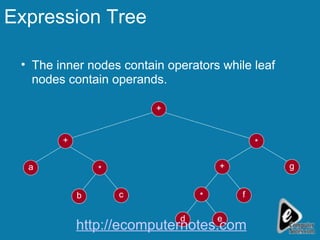
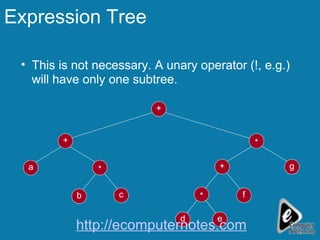
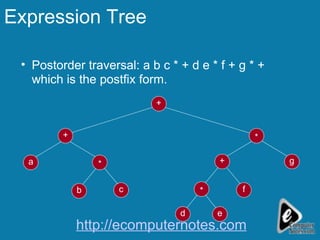
Expression Tree The inner nodes contain operators while leaf nodes contain operands. a c + b g * + + d * * e f http://ecomputernotes.com
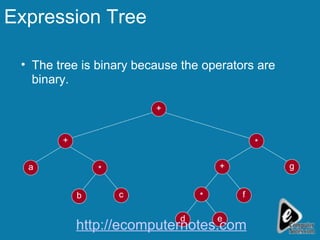
Expression Tree The tree is binary because the operators are binary. a c + b g * + + d * * e f http://ecomputernotes.com
Expression Tree This is not necessary. A unary operator (!, e.g.) will have only one subtree. a c + b g * + + d * * e f http://ecomputernotes.com
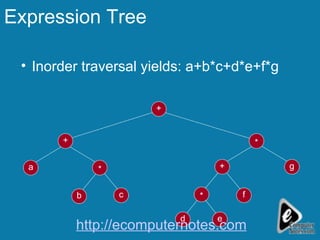
Expression Tree Inorder traversal yields: a+b*c+d*e+f*g a c + b g * + + d * * e f http://ecomputernotes.com
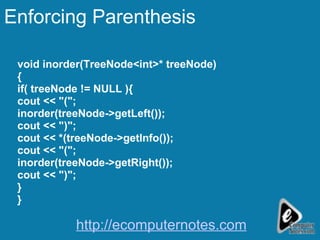
Enforcing Parenthesis void inorder(TreeNode<int>* treeNode) { if( treeNode != NULL ){ cout << &quot;(&quot;; inorder(treeNode->getLeft()); cout << &quot;)&quot;; cout << *(treeNode->getInfo()); cout << &quot;(&quot;; inorder(treeNode->getRight()); cout << &quot;)&quot;; } } http://ecomputernotes.com
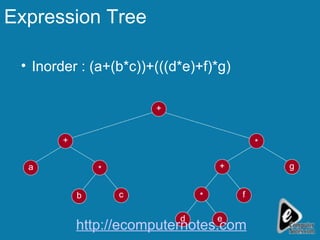
Expression Tree Inorder : (a+(b*c))+(((d*e)+f)*g) a c + b g * + + d * * e f http://ecomputernotes.com
Expression Tree Postorder traversal: a b c * + d e * f + g * + which is the postfix form. a c + b g * + + d * * e f http://ecomputernotes.com
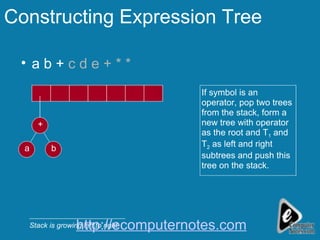
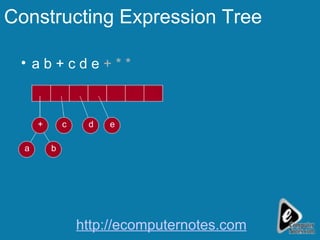
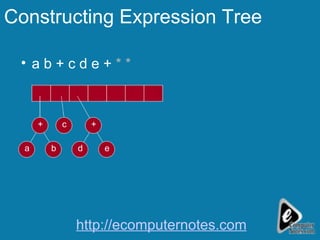
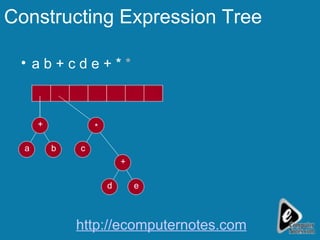
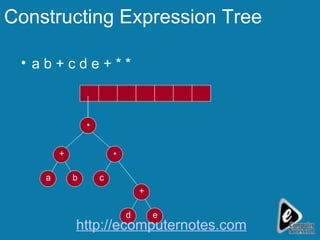
Constructing Expression Tree Algorithm to convert postfix expression into an expression tree. We already have an expression to convert an infix expression to postfix. Read a symbol from the postfix expression. If symbol is an operand, put it in a one node tree and push it on a stack. If symbol is an operator, pop two trees from the stack, form a new tree with operator as the root and T 1  and T 2  as left and right subtrees and push this tree on the stack. http://ecomputernotes.com
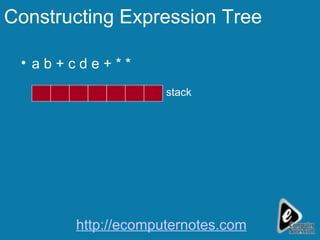
Constructing Expression Tree a b + c d e + * * stack http://ecomputernotes.com
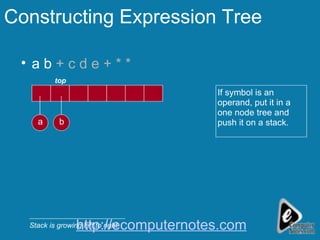
Constructing Expression Tree a b  + c d e + * * b a Stack is growing left to right If symbol is an operand, put it in a one node tree and push it on a stack. top http://ecomputernotes.com
Constructing Expression Tree a b +  c d e + * * b a Stack is growing left to right + If symbol is an operator, pop two trees from the stack, form a new tree with operator as the root and T 1  and T 2  as left and right subtrees and push this tree on the stack. http://ecomputernotes.com
Constructing Expression Tree a b +   c d e  + * * b a + d c e http://ecomputernotes.com
Constructing Expression Tree a b +   c d e   +  * * b a + c e d + http://ecomputernotes.com
Constructing Expression Tree a b +   c d e   +   *  * b a + c e d + * http://ecomputernotes.com
Constructing Expression Tree a b +   c d e   +   *   * b a + c e d + * * http://ecomputernotes.com
Other Uses of Binary Trees Huffman Encoding http://ecomputernotes.com
Huffman Encoding Data compression plays a significant role in computer networks. To transmit data to its destination faster, it is necessary to either increase the data rate of the transmission media or to simply send less data.  Improvements with regard to the transmission media has led to increase in the rate. The other options is to send less data by means of data compression. Compression methods are used for text, images, voice and other types of data (space probes). http://ecomputernotes.com
Huffman Encoding Huffman code is method for the compression for standard text documents. It makes use of a binary tree to develop codes of varying lengths for the letters used in the original message.  Huffman code is also part of the JPEG image compression scheme. The algorithm was introduced by David Huffman in 1952 as part of a course assignment at MIT. http://ecomputernotes.com http://ecomputernotes.com
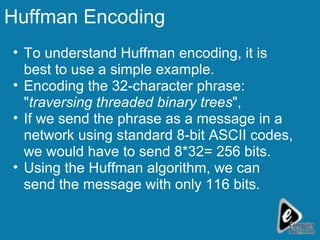
Huffman Encoding To understand Huffman encoding, it is best to use a simple example.  Encoding the 32-character phrase: &quot; traversing threaded binary trees &quot;,  If we send the phrase as a message in a network using standard 8-bit ASCII codes, we would have to send 8*32= 256 bits. Using the Huffman algorithm, we can send the message with only 116 bits.
Huffman Encoding List all the letters used, including the &quot;space&quot; character, along with the frequency with which they occur in the message.  Consider each of these (character,frequency) pairs to be nodes; they are actually leaf nodes, as we will see.  Pick the two nodes with the lowest frequency, and if there is a tie, pick randomly amongst those with equal frequencies.
Huffman Encoding Make a new node out of these two, and make the two nodes its children.  This new node is assigned the sum of the frequencies of its children.  Continue the process of combining the two nodes of lowest frequency until only one node, the root, remains.
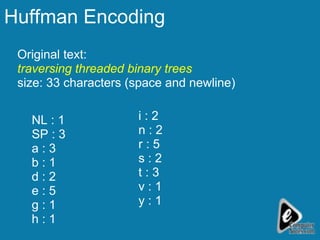
Huffman Encoding Original text:  traversing threaded binary trees size: 33 characters (space and newline) NL : 1 SP : 3 a : 3 b : 1 d : 2 e : 5 g : 1 h : 1 i : 2 n : 2 r : 5 s : 2 t : 3 v : 1 y : 1
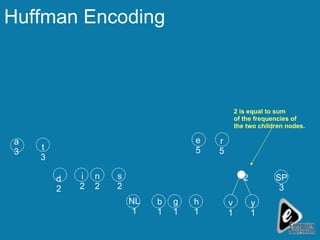
Huffman Encoding v 1 y 1 SP 3 r 5 h 1 e 5 g 1 b 1 NL 1 s 2 n 2 i 2 d 2 t 3 a 3 2 2 is equal to sum  of the frequencies of  the two children nodes.
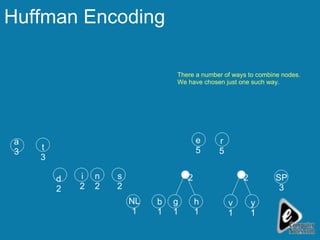
Huffman Encoding v 1 y 1 SP 3 r 5 h 1 e 5 g 1 b 1 NL 1 s 2 n 2 i 2 d 2 t 3 a 3 2 2 There a number of ways to combine nodes. We have chosen just one such way.
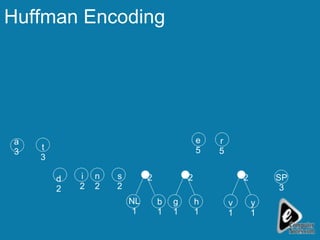
Huffman Encoding v 1 y 1 SP 3 r 5 h 1 e 5 g 1 b 1 NL 1 s 2 n 2 i 2 d 2 t 3 a 3 2 2 2
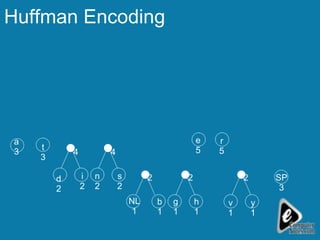
Huffman Encoding v 1 y 1 SP 3 r 5 h 1 e 5 g 1 b 1 NL 1 s 2 n 2 i 2 d 2 t 3 a 3 2 2 2 4 4
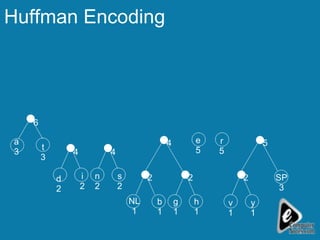
Huffman Encoding v 1 y 1 SP 3 r 5 h 1 e 5 g 1 b 1 NL 1 s 2 n 2 i 2 d 2 t 3 a 3 2 2 2 5 4 4 4 6
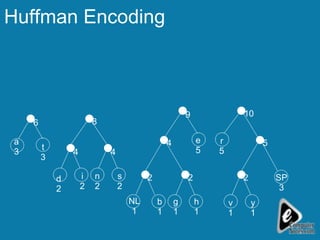
Huffman Encoding v 1 y 1 SP 3 r 5 h 1 e 5 g 1 b 1 NL 1 s 2 n 2 i 2 d 2 t 3 a 3 2 2 2 5 4 4 4 8 6 9 10
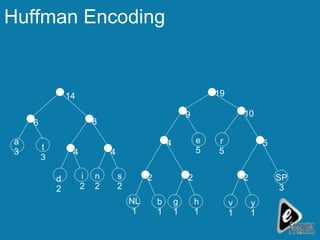
Huffman Encoding v 1 y 1 SP 3 r 5 h 1 e 5 g 1 b 1 NL 1 s 2 n 2 i 2 d 2 t 3 a 3 2 2 2 5 4 4 4 8 6 14 9 19 10
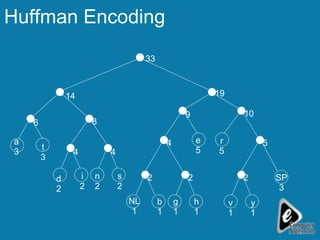
Huffman Encoding v 1 y 1 SP 3 r 5 h 1 e 5 g 1 b 1 NL 1 s 2 n 2 i 2 d 2 t 3 a 3 2 2 2 5 4 4 4 8 6 14 9 19 10 33

computer notes - Data Structures - 23

  • 1.
    Class No.23 Data Structures http://ecomputernotes.com
  • 2.
    Expression Tree Theinner nodes contain operators while leaf nodes contain operands. a c + b g * + + d * * e f http://ecomputernotes.com
  • 3.
    Expression Tree Thetree is binary because the operators are binary. a c + b g * + + d * * e f http://ecomputernotes.com
  • 4.
    Expression Tree Thisis not necessary. A unary operator (!, e.g.) will have only one subtree. a c + b g * + + d * * e f http://ecomputernotes.com
  • 5.
    Expression Tree Inordertraversal yields: a+b*c+d*e+f*g a c + b g * + + d * * e f http://ecomputernotes.com
  • 6.
    Enforcing Parenthesis voidinorder(TreeNode<int>* treeNode) { if( treeNode != NULL ){ cout << &quot;(&quot;; inorder(treeNode->getLeft()); cout << &quot;)&quot;; cout << *(treeNode->getInfo()); cout << &quot;(&quot;; inorder(treeNode->getRight()); cout << &quot;)&quot;; } } http://ecomputernotes.com
  • 7.
    Expression Tree Inorder: (a+(b*c))+(((d*e)+f)*g) a c + b g * + + d * * e f http://ecomputernotes.com
  • 8.
    Expression Tree Postordertraversal: a b c * + d e * f + g * + which is the postfix form. a c + b g * + + d * * e f http://ecomputernotes.com
  • 9.
    Constructing Expression TreeAlgorithm to convert postfix expression into an expression tree. We already have an expression to convert an infix expression to postfix. Read a symbol from the postfix expression. If symbol is an operand, put it in a one node tree and push it on a stack. If symbol is an operator, pop two trees from the stack, form a new tree with operator as the root and T 1 and T 2 as left and right subtrees and push this tree on the stack. http://ecomputernotes.com
  • 10.
    Constructing Expression Treea b + c d e + * * stack http://ecomputernotes.com
  • 11.
    Constructing Expression Treea b + c d e + * * b a Stack is growing left to right If symbol is an operand, put it in a one node tree and push it on a stack. top http://ecomputernotes.com
  • 12.
    Constructing Expression Treea b + c d e + * * b a Stack is growing left to right + If symbol is an operator, pop two trees from the stack, form a new tree with operator as the root and T 1 and T 2 as left and right subtrees and push this tree on the stack. http://ecomputernotes.com
  • 13.
    Constructing Expression Treea b + c d e + * * b a + d c e http://ecomputernotes.com
  • 14.
    Constructing Expression Treea b + c d e + * * b a + c e d + http://ecomputernotes.com
  • 15.
    Constructing Expression Treea b + c d e + * * b a + c e d + * http://ecomputernotes.com
  • 16.
    Constructing Expression Treea b + c d e + * * b a + c e d + * * http://ecomputernotes.com
  • 17.
    Other Uses ofBinary Trees Huffman Encoding http://ecomputernotes.com
  • 18.
    Huffman Encoding Datacompression plays a significant role in computer networks. To transmit data to its destination faster, it is necessary to either increase the data rate of the transmission media or to simply send less data. Improvements with regard to the transmission media has led to increase in the rate. The other options is to send less data by means of data compression. Compression methods are used for text, images, voice and other types of data (space probes). http://ecomputernotes.com
  • 19.
    Huffman Encoding Huffmancode is method for the compression for standard text documents. It makes use of a binary tree to develop codes of varying lengths for the letters used in the original message. Huffman code is also part of the JPEG image compression scheme. The algorithm was introduced by David Huffman in 1952 as part of a course assignment at MIT. http://ecomputernotes.com http://ecomputernotes.com
  • 20.
    Huffman Encoding Tounderstand Huffman encoding, it is best to use a simple example. Encoding the 32-character phrase: &quot; traversing threaded binary trees &quot;, If we send the phrase as a message in a network using standard 8-bit ASCII codes, we would have to send 8*32= 256 bits. Using the Huffman algorithm, we can send the message with only 116 bits.
  • 21.
    Huffman Encoding Listall the letters used, including the &quot;space&quot; character, along with the frequency with which they occur in the message. Consider each of these (character,frequency) pairs to be nodes; they are actually leaf nodes, as we will see. Pick the two nodes with the lowest frequency, and if there is a tie, pick randomly amongst those with equal frequencies.
  • 22.
    Huffman Encoding Makea new node out of these two, and make the two nodes its children. This new node is assigned the sum of the frequencies of its children. Continue the process of combining the two nodes of lowest frequency until only one node, the root, remains.
  • 23.
    Huffman Encoding Originaltext: traversing threaded binary trees size: 33 characters (space and newline) NL : 1 SP : 3 a : 3 b : 1 d : 2 e : 5 g : 1 h : 1 i : 2 n : 2 r : 5 s : 2 t : 3 v : 1 y : 1
  • 24.
    Huffman Encoding v1 y 1 SP 3 r 5 h 1 e 5 g 1 b 1 NL 1 s 2 n 2 i 2 d 2 t 3 a 3 2 2 is equal to sum of the frequencies of the two children nodes.
  • 25.
    Huffman Encoding v1 y 1 SP 3 r 5 h 1 e 5 g 1 b 1 NL 1 s 2 n 2 i 2 d 2 t 3 a 3 2 2 There a number of ways to combine nodes. We have chosen just one such way.
  • 26.
    Huffman Encoding v1 y 1 SP 3 r 5 h 1 e 5 g 1 b 1 NL 1 s 2 n 2 i 2 d 2 t 3 a 3 2 2 2
  • 27.
    Huffman Encoding v1 y 1 SP 3 r 5 h 1 e 5 g 1 b 1 NL 1 s 2 n 2 i 2 d 2 t 3 a 3 2 2 2 4 4
  • 28.
    Huffman Encoding v1 y 1 SP 3 r 5 h 1 e 5 g 1 b 1 NL 1 s 2 n 2 i 2 d 2 t 3 a 3 2 2 2 5 4 4 4 6
  • 29.
    Huffman Encoding v1 y 1 SP 3 r 5 h 1 e 5 g 1 b 1 NL 1 s 2 n 2 i 2 d 2 t 3 a 3 2 2 2 5 4 4 4 8 6 9 10
  • 30.
    Huffman Encoding v1 y 1 SP 3 r 5 h 1 e 5 g 1 b 1 NL 1 s 2 n 2 i 2 d 2 t 3 a 3 2 2 2 5 4 4 4 8 6 14 9 19 10
  • 31.
    Huffman Encoding v1 y 1 SP 3 r 5 h 1 e 5 g 1 b 1 NL 1 s 2 n 2 i 2 d 2 t 3 a 3 2 2 2 5 4 4 4 8 6 14 9 19 10 33

Editor's Notes

  • #3 Start of lecture 25.
  • #22 Start of Lecture 26
  • #32 End of lecture 25.